

Google has been experimenting with AI in search for years, but Google AI Overviews mark a real turning point. For many queries, especially informational and exploratory ones, users see an AI-generated summary before they ever reach the familiar “10 blue links.”
That change is reshaping the search experience. And for marketing leaders, the shift isn’t theoretical – it’s happening now:
- AI Overviews have expanded to cover a much larger share of queries, particularly in education, B2B technology, and complex how‑to topics. Source: Search Engine Journal
- Multiple analyses have found significant drops in organic clicks from traditional Search Engine Results Pages (SERPs), even as impressions hold steady or rise. Sources: Search Engine Land, McKinsey
- Google is testing more immersive “AI modes” for deeper research journeys, while still adjusting and removing AI Overviews when engagement is low. Source: Search Engine Land
In other words: the front door to your brand is moving.
Here, we’ll focus on how Google AI Overviews are changing search behavior, as well as the results page experience, so you can ground your stakeholders and leadership team in the reality of what’s happening.
When you’re ready to move from context to action, Marketing Strategies to Win with Google AI Overviews outlines how to adapt your search portfolio, content, and dashboards.
Why Google AI Overviews Matter for Marketing Leaders
If you’re responsible for pipeline, revenue, and brand visibility, AI Overviews matter for three big reasons.
1. They compress the decision journey
AI Overviews aggregate answers from multiple sources into a single, scannable summary. For many users, that can:
- Replace the need to click into multiple articles.
- Shorten the time from question to next action.
- Shift attention from individual brands to the overall “consensus” answer.
The net effect: fewer opportunities for your brand to earn attention via traditional organic listings alone.
2. They redirect, not remove, demand
While some reports show organic clicks declining by double‑digit percentages for certain query types, they also highlight growth in breaking news, Google Discover, and other surfaces.
That tells an important story:
- Demand for information hasn’t disappeared; it’s being rerouted.
- Topical, timely, and highly authoritative content can still win disproportionate visibility.
- Brands that diversify how they show up in search see less volatility when Google changes the interface.
3. They reward clarity, authority, and freshness
Analyses of AI Overview triggers show that they appear overwhelmingly on:
- Non‑branded, informational queries.
- Longer question‑shaped searches (e.g., “how to…”, “what is…”, “best way to…”).
- Topics where there’s enough high‑quality content for the model to synthesize.
Source: Ahrefs
That’s an opportunity. If you consistently publish clear, well‑structured, up‑to‑date content that answers these kinds of questions better than anyone else, you increase your odds of being cited or surfaced in AI Overviews—even if you’re not explicitly “optimizing for AI.”
How Google AI Overviews Change the SERP Experience
To build the right strategy, it helps to be specific about what’s actually changed in the SERP.
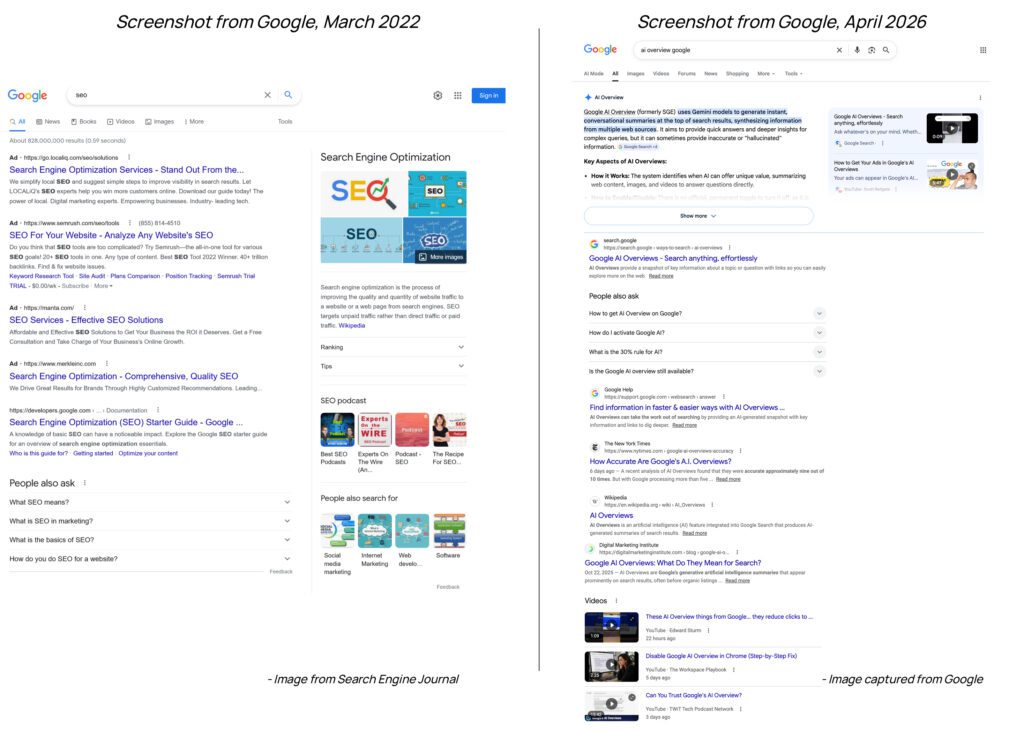
From linear listings to layered experiences, a typical results page used to look like:
- Paid ads at the top
- Organic listings
- Maybe a featured snippet or People Also Ask box
With Google AI Overviews, the SERP experience can become:
- AI Overview card summarizing the answer
- Supporting links cited by the AI
- Traditional organic listings
- Additional modules (People Also Ask, videos, Discover‑like carousels, Reddit Threads, etc.)
Your listing might still be “on page 1”, but pushed below a large AI module that already answers most of the question.
Higher variance by query type
AI Overviews don’t appear on every query, and Google is actively optimizing when and how they show up based on engagement. Patterns from recent analyses suggest:
- Informational, research, and how‑to queries: High likelihood of AI Overviews.
- YMYL (Your Money, Your Life) topics like health, finance, and higher education are more likely to trigger AI Overviews. Sources: Ahrefs, SE Ranking
- Branded and strong commercial‑intent queries: Google often prioritizes the more traditional layout to match the query, like a specific brand or company.
Sources: Ahrefs, Search Engine Journal
That means you’ll see the biggest impact on organic visibility and click-through rates for top- and mid‑funnel informational queries, with branded, bottom‑funnel searches being less affected.
New ways users can explore
Google has also been testing more immersive “AI modes” that encourage users to:
- Refine or expand their question conversationally.
- Explore related angles and follow‑up questions suggested by the AI.
- Stay within a richer, more guided interface instead of bouncing back and forth between search and websites.
For marketers, the implication is clear: you’re no longer just competing for a click—you’re competing to become part of the AI’s narrative.
What This Shift Means for Your Team
AI Driven search changes how your team should think about content and performance. For example:
- Build Authority – Since AI pulls from multiple sources, it tends to favor reputable brands and consistent publishers. Marketers should shift their content goals toward building authority and being recognized as a trusted leader in their industry.
- Create Content Clusters – In the past, one strong blog or post could bring in site traffic, Now, with AI summarizing multiple sources, marketers need to create a connected set of content around key topics to show up as a credible source. An example would be a blog post with links to a case study, a playbook, and a guide.
- Measure AIO Visibility – Success can no longer be measured by clicks alone. Teams should also track visibility in AI Overviews, assess whether their brand is influencing AI-generated answers, and evaluate whether they are effectively addressing user queries—even when users don’t visit their site directly.
If you are looking for next steps, read Marketing Strategies to Win with Google AI Overviews to discover real-world strategies —from redesigning content strategy to updating dashboards and experimentation plans.
Sources
– What’s hot, what’s not: AI search changes in Q1 2026 (Search Engine Journal)
– AI Overview triggers: When and why Google shows AI answers (Ahrefs)
– Google AI Overviews cut search clicks – report (Search Engine Land)
– The new front door to the internet: Winning in the age of AI search (McKinsey)
– AI Overviews Research: Analyzing Google’s approach to YMYL topics (SE Ranking)